
Concrete Cutting
Concrete Cutting vs Breaking: Which One Your Project Actually Needs
- concrete cutting
- concrete removal
- planning
If you've got concrete that needs to go, you'll hear two options: cut it or break it. They sound like two ways of doing the same thing, and sometimes they are. But on a lot of jobs, picking the wrong one means cracked floors, rough openings or a mess that spreads further than it should.
Here's a plain look at what each method does well, where it falls short and how to tell which one your project needs.
What cutting actually means
Cutting uses diamond blades on floor saws, wall saws, handheld saws or core drills. The blade grinds a narrow kerf through the concrete, usually with water running to it. You end up with a line, a square opening or a round hole exactly where it was marked.
When a section needs to come out, it's cut into blocks that can be lifted or carried away. That's what you see on an indoor slab that's been scored into a grid: each piece lifts out on its own, and the concrete around it isn't touched.
What breaking actually means
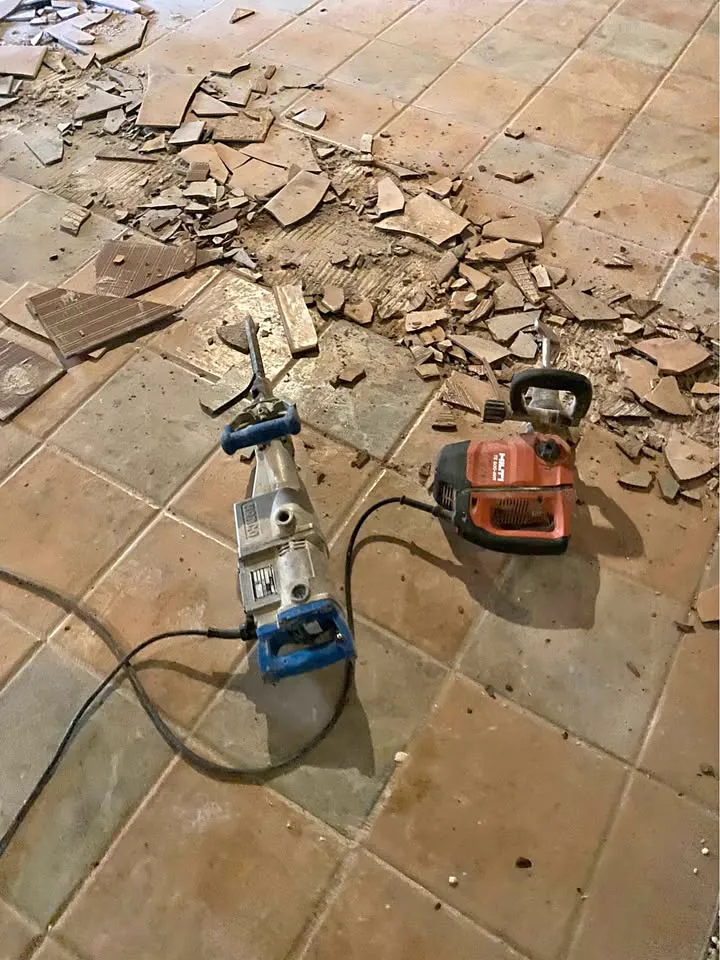
Breaking uses impact. Jackhammers, chipping hammers, hydraulic breakers on machines and sometimes plain sledgehammers fracture the concrete into rubble. It's fast to start, needs less set-up and works well when the whole thing is going.
The catch is that impact doesn't stop neatly at a line. Cracks can run into concrete you meant to keep, and vibration travels through the structure.
When cutting is the smarter choice
Cutting earns its set-up time when:
- You're making an opening for a door, window or walkout
- The concrete around the removal has to stay intact
- There are finished rooms, tile or drywall close by
- The building is attached and vibration could reach a neighbour
- The edges will be exposed or carry a lintel
- You want less airborne dust indoors
When breaking makes more sense
Breaking is often the practical pick for full slab removals outdoors, old pads and walkways, footings that are coming out completely and any job where nothing fragile is nearby. It's also common to combine the two: saw-cut the perimeter so the break stops where you want it, then break out the middle. That's how a strip of industrial floor can be removed down to the base while the rest of the shop floor stays in service.
If you're not sure, ask what happens at the edges. That's usually where the choice gets made.
Dust, noise and clean-up
Both methods create silica, which is why wet cutting and water on breaking are standard. Wet cutting produces slurry that has to be collected, while breaking produces dust and rubble. Breaking tends to be louder in bursts, and cutting is a steadier whine. Clean-up is easier with cut blocks, since they're solid pieces instead of piles of gravel and fines.
When it makes sense to bring in a professional
Renting a jackhammer for a small walkway is something plenty of homeowners do. But anything involving a foundation wall, a structural slab, buried services or finished space nearby is worth handing off. A pro will check what's under or inside the concrete, knows when a permit or engineer is needed, has the right saws and can get rid of the material properly.
You can see both approaches on our concrete cutting and concrete removal pages.
The bottom line
Cutting is about precision and protecting what stays. Breaking is about speed when everything's going. Plenty of jobs use both. If you'd like a straight answer for your own project, CoreCut Demolition Mississauga will come out, look at the concrete and tell you which approach fits. Request a free estimate to get started.
Frequently asked questions
Is cutting always more expensive than breaking?
Not necessarily. Cutting takes more set-up, but it can reduce repair work and clean-up afterwards. The job itself decides which works out better.
Can you cut and break on the same job?
Yes, and it's common. The edges are saw-cut first, then the middle is broken out.
Which method makes less mess indoors?
Wet cutting usually makes less airborne dust, though the slurry has to be contained and collected.
Will breaking crack my foundation?
It can if it's done near concrete that stays. Saw-cutting the boundary first greatly reduces the risk.
Primary planning references
Source links checked 6 October 2026. Confirm the requirements for your property and scope with the relevant authority and qualified professionals.