
Concrete Cutting
What is the difference between wall sawing and hand breaking a wall?
- wall sawing
- breaking
- concrete walls
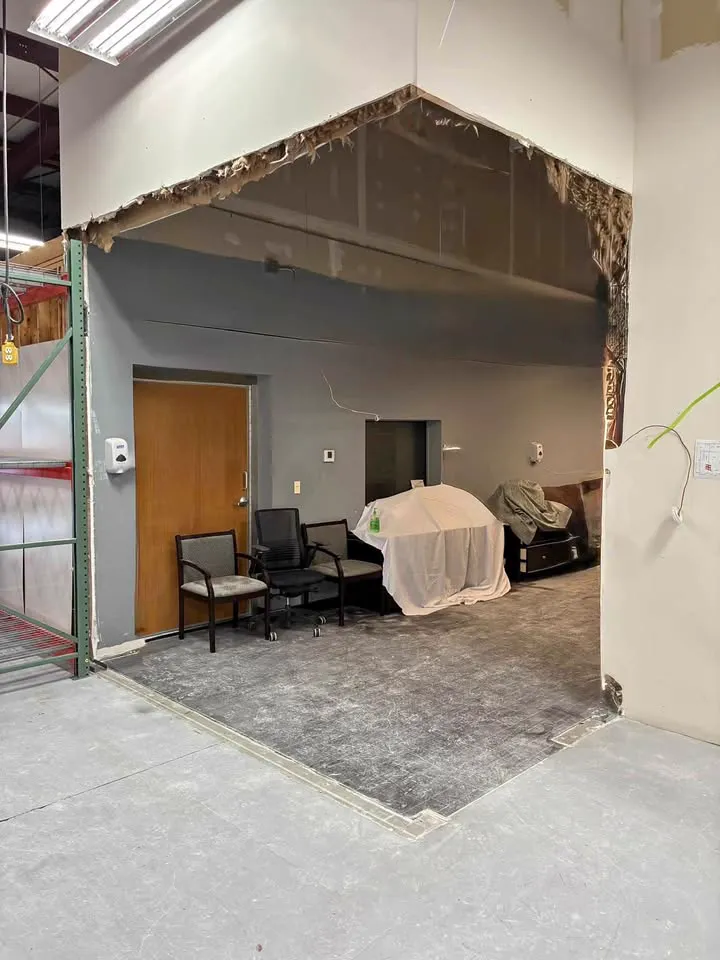
Wall sawing uses a diamond blade on a track to cut straight through a concrete wall, so the section comes out in clean blocks with square edges. Hand breaking uses hammers and breakers to fracture the concrete into rubble, which is faster to start but leaves rough edges and sends more vibration through the building.
Which one fits depends on what the opening is for, what is around it and how much the finished edge matters. Here is how they compare.
How wall sawing works
A wall saw is a motor and blade mounted on a track bolted to the wall. The blade makes passes along the layout line, going deeper each time until it cuts through. Water feeds to the blade the whole time. Once the perimeter is cut, the section is usually cut into smaller blocks and removed with lifting equipment or by hand.
The result is an opening that matches the layout to within a small tolerance, with smooth faces that a lintel, door buck or window frame can sit against.
How hand breaking works
Hand breaking uses electric or pneumatic breakers, chipping hammers and sometimes sledgehammers. The concrete is fractured bit by bit from the centre outward, rebar is cut with a grinder or torch and the rubble is shovelled out. The edges are cleaned up afterwards, but they stay irregular.
Side-by-side comparison
The main differences come down to a few factors:
- Edge quality: sawing gives straight, square edges; breaking leaves rough faces
- Vibration: sawing is smooth; breaking hammers the wall and nearby finishes
- Dust: wet sawing controls silica at the blade; breaking creates more airborne dust
- Noise: both are loud, but breaking produces sharp repeated impacts
- Debris: sawing leaves solid blocks; breaking leaves rubble to shovel
- Set-up: sawing needs power, water and track mounting; breaking starts almost right away
When breaking still makes sense
For small, rough openings where the edge will be hidden, in unfinished spaces or where a wall is coming down entirely, breaking can be the practical choice. Breaking is also common for removing slabs once the edges have been saw-cut to stop cracks spreading into the concrete that stays. Our concrete removal page shows that combination in an industrial floor.
When sawing is the better choice
Sawing is the stronger option for new doors, windows and walkouts in foundation walls, openings next to finished rooms, walls that carry load and anywhere the edges will be exposed or need to bear on a lintel. It is also the gentler option in attached homes, where vibration can travel into a neighbour's side.
Questions to ask before choosing
A few quick questions usually settle it. Will the edge be seen or need to carry a lintel? Is there a finished room, a neighbour's wall or tile within a few feet? Does the building need to stay occupied and reasonably quiet? Is there power and water on site? If the answer to the first three is yes, sawing is almost always worth the set-up.
What we do about it
CoreCut Demolition Mississauga does both, and we will recommend one after seeing the wall. For openings in foundations and walls that stay, we wall saw wet and lift the sections out in blocks, as shown on our concrete cutting page. For rough removals, we break, contain the dust and haul the rubble for recycling.
To get a recommendation for your wall, request a free estimate.
Frequently asked questions
Is wall sawing much quieter than breaking?
It is still loud, but it avoids the sharp repeated impacts of breakers. Neighbours usually find it easier to live with.
Can wall sawing cut through rebar?
Yes. Diamond blades cut through reinforcing steel along with the concrete.
Does breaking damage the rest of the wall?
It can cause cracking beyond the opening, especially in older concrete. Saw-cutting the perimeter first reduces that risk.
Which method is better for block walls?
Both are used. Sawing gives cleaner edges on block, while breaking may be used where the edge will be rebuilt.
Primary planning references
Source links checked 6 October 2026. Confirm the requirements for your property and scope with the relevant authority and qualified professionals.